How to practice writing kanji from memory
A useful kanji writing session has three parts: look at the model, make an attempt, and check what changed. This routine works with paper and a pencil or with the writing canvas in KanjiBrush for iPhone and Android.
Try three characters in your browser
Copy beside the model, or hide it and try from memory. You can keep drawing when you reveal it to compare and correct your attempt. Use a finger, pen or mouse—or use paper and the keyboard controls. This is a self-check exercise; it does not automatically recognize or grade handwriting.
JavaScript enables the interactive practice below. You can also use the written 日・目・田 drill on this page without JavaScript.
Model hidden. Draw from memory, then reveal it to compare.
You finished the three-character self-check.
Which inner pattern was hardest to recall? Make one more attempt later without opening the model. For guided practice and automated stroke feedback in the app, start with Grade 1 free.


All 80 Grade 1 kanji start free. Optional subscriptions unlock further grades and study modes; current prices appear before purchase.
Models derived from KanjiVG, © Ulrich Apel and contributors, CC BY-SA 3.0. Geometry is unchanged; presentation and the self-check interface are adapted. Source revision and path data. Drawings stay in this page’s memory and are not uploaded or saved.
1. Choose a small set you can actually check
Start with a few characters, such as 日, 月 and 木. Look at each character's meaning and the word in which you encountered it. Knowing a shape's English label alone does not tell you how every word containing that kanji is read.
KanjiBrush organizes practice by school grade and uses focused rounds. Grade 1 contains 80 kanji and is available to start free; optional premium plans unlock further grades and study modes.
2. Trace while paying attention to direction
Follow one stroke at a time. Notice the starting point, where the stroke crosses another line, and where you lift your finger or pen. A completed outline can hide these decisions. Tracing is a way to inspect the model, not evidence that you can already reproduce it without help.

3. Remove the guide and write from memory
Make one attempt without the character visible. If you stop halfway, note the point where you stopped before revealing the model. You might remember the pieces but not their order, or the order but not the direction of a crossing stroke. Those are different corrections.
On paper, cover the example. In KanjiBrush, use the writing-from-memory part of practice. Make a real attempt before checking the answer; immediately tracing the same model again does not test the same skill.
4. Correct one specific detail
Compare stroke order and direction, then look at the main proportions. Name one difference: “the middle line is too short,” “I started the sweep at the wrong end,” or “I forgot the last stroke.” Write the corrected character once, then mix it with another character before trying again.
KanjiBrush gives feedback on stroke order, direction and shape. Treat the result as a practice cue. It is a comparison with the app model, not a calligraphy certificate or a guarantee about an examiner's assessment.
A worked drill: 日, 目 and 田
These three characters are a useful small set because one remembered rectangle is not enough to distinguish them. Check the model for the strokes, then hide it and write the character for each meaning.
- 日 — sun or day, 4 strokes. There is one horizontal line inside the outer shape.
- 目 — eye, 5 strokes. There are two horizontal lines inside the outer shape.
- 田 — rice field, 5 strokes. A vertical and a horizontal line divide the inside into four spaces.
Stroke counts describe pen movements, not visible line segments. In these models the top and right sides of the outer shape are made in one turning stroke. Watch that corner before deciding that a rectangle needs four separate strokes.
Try the meaning prompts without the model
- Write the character for eye.
- Write the character for sun or day.
- Write the character for rice field.
Reveal the answers and one thing to check
- 目 — check for two inner horizontal lines.
- 日 — check that you have only one inner horizontal line.
- 田 — check for the crossing lines inside.
If you chose the wrong character, name the inner pattern before drawing again. If the character is right but the stroke count differs, compare the pen lifts with the model. Those two errors need different corrections.
Watch 日, 目 and 田 in the free KanjiSteps browser desk; its stroke models are adapted from KanjiVG. The drill is an educational example you can do on paper. For app practice, open KanjiBrush on iPhone or Android and use its model and feedback. You can also choose a different small set from the 80-character Grade 1 reference.
A second pair: 土 and 士
Both characters have 3 strokes, so counting pen lifts cannot tell them apart. The useful distinction is which horizontal line is longer.
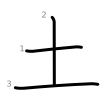
The lower horizontal is longer.
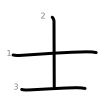
The upper horizontal is longer.
In both models, write the upper horizontal from left to right first, the vertical from top to bottom second, and the lower horizontal from left to right third. Keep the relative lengths in mind rather than giving both characters the same pair of bars.
Cover, alternate, compare
- Look at each numbered model, then cover both.
- Write soil, scholar, then soil again without copying.
- Uncover the models. For each attempt, check whether the longer horizontal is in the right place, then check stroke order and direction.
Reveal the meaning prompts and correction cue
土・士・土. Soil has the wider base; scholar has the wider upper horizontal. If you swapped them, say which line should be longer before making one corrected attempt. Three strokes alone do not establish a correct character.
Numbered models from KanjiVG, © Ulrich Apel and contributors, CC BY-SA 3.0. Original geometry and stroke numbering are unchanged. Pinned source revision and SVG hashes.
Take all five characters to paper
Open the 日・目・田・土・士 worksheet preset in KanjiSteps →
Open the worksheet view in KanjiSteps, then choose Print / Save PDF. Its sheet provides numbered models, faded tracing guides and blank writing grids. Trace once, cover the model, and use a blank grid for recall. Compare the inner patterns in 日・目・田 and the horizontal lengths in 土・士 yourself; the sheet does not grade handwriting. These are five separate practice characters, not a sentence or a reading exercise.
Connect the character to a word
Try 木 and then 木曜日, “Thursday.” In that word 木 is read もく. In the word 木 for a tree it can be read き. Readings belong to words and context, so learning one pronunciation for a character is not enough to read every compound.
Likewise, 日 appears in 日本, “Japan,” and 日曜日, “Sunday,” with readings that depend on the word. Use the app's readings and example words when connecting the character you draw to the language you want to read.
A short session you can repeat
- Choose three familiar kanji and look at their readings and meanings.
- Trace each one while noticing the pen lifts.
- Hide the guide and write each character once.
- Check one difference and make a corrected attempt.
- At your next session, try one of those characters before opening its model.
Keep a note of what was uncertain rather than setting a target for how many pages to fill. A shorter session with a correction you can explain is easier to continue than a stack of unexamined copies.
Phone practice and free browser practice
Use KanjiBrush on iPhone or Android when you want an app canvas and automated stroke feedback. For a sentence from a lesson or diary, the free companion KanjiSteps browser practice desk shows kana and kanji animations and can make a printable sheet. It does not score your handwriting.
Try the three characters in KanjiSteps →For wider language study, the Japan Foundation's Irodori Starter provides structured lessons. This page focuses on the practice routine, not a complete Japanese course.